
Types of Cell Division :There are mainly three types of cell division
- Mitotic Division – In Prokaryotic Organisms
- Mitosis or Mitosis – In somatic cells
- 3 Meiosis – In progenitor cells
Cell division and cell cycle
Table of Contents
Types of Cell Division – Cells of all living organisms divide into two parts, in which each parent cell divides to form two new daughter cells, these newly created daughter cells themselves grow and divide again.
What is cell cycle?
Cell division is an important process for all living organisms. During a cell division, DNA replication and cell growth take place, the cell doubles its genome and synthesizes other components and then divides to form two new daughter cells, this is called the cell cycle. Although cell growth (in the context of cytoplasmic growth) is a continuous process, the synthesis of DNA occurs at a specific stage of the cell cycle. During cell division, the replicated chromosomes (DNA) are distributed to the daughter nuclei by a complex sequence of events. All these events are under genetic control.
An example of a phenotypic (eukaryotic) cycle is in the culture of the human cell, which divides approximately every twenty-four hours. However, this period of the cell cycle may vary from organism to organism and cell to cell pattern. For example, the cell cycle of yeast takes about ninety minutes to complete.
phases of the cell cycle
The duration of the cell cycle may change from one organism to another and from cell to organism and from cell to cell pattern. There are two basic phases of the cell cycle which are as follows:
- Interphase
- Mitosis Phase
interphase
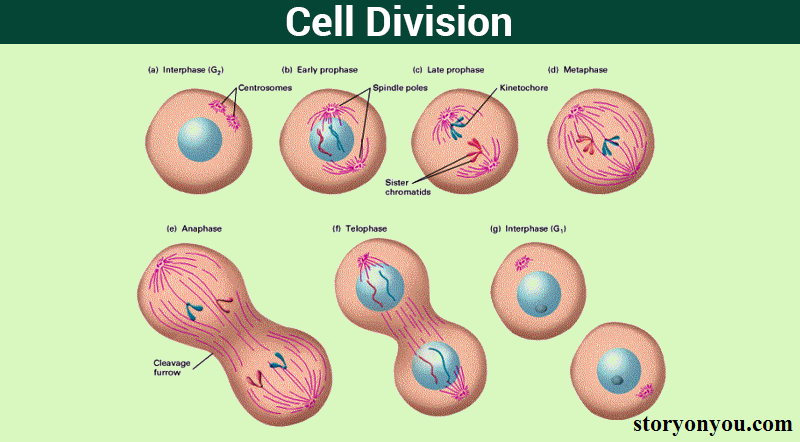
Before the start of mitotic division there is an interphase in which G1, S and G2 are sub-phases. The interstate is also called the resting state. This is the phase in which the cell is ready for division and during this both cell growth and DNA replication take place in an orderly manner. Interphase is divided into three phases or sub-phases:
- Post-Point Interval Phase (G1 Phase or G1 Phase)
- Synthesis Phase (S Phase or S Phase)
- Pre-Point Division Interval Phase (G2 Phase or G2 Phase)
G1 – Synthesis of proteins and RNA takes place.
S – In this, diploidy of DNA and synthesis of histone proteins takes place.
G2 – Synthesis of RNA and protein takes place.
G0 – In this the cell becomes specialized and after this cell division does not take place.
In the G1 phase, the cell is metabolically active, and continues to grow, but its DNA does not replicate. During the S phase or the synthesis phase, DNA is created and replicated. During this the amount of DNA doubles.
During the S phase in the animal cell, as soon as the replication of DNA begins in the nucleus, the replication of the centrosome starts in the cytoplasm, along with cell growth, proteins are produced during the G2 phase for mitotic division.
Cells that do not divide further go from the G1 phase to the dormant phase, which is called the silent phase (G0) of the cell cycle.
In animals, mitotic division is visible only in diploid somatic cells. In contrast, in plants, mitotic division is seen in both haploid and diploid cells.
Mitosis
In all animals and plants, germ cells and all other cells divide by mitotic division. This cell division was discovered by W. Fleming did. It occurs in all types of vegetative cells. In this, two identical daughter cells are formed from a diploid mother cell. The process of mitosis takes place in two parts: nuclear division and cytoplasmic division.
Mitotic division (M phase) denotes the stage in which cell division or mitosis actually occurs, and interphase refers to the phase between two successive M phases, the cell
What is cell division? What is cell cycle? , Meiosis and Meiosis
In this article, we will know what is cell division? What are the types of koshika vibhajan? Why is koshika vibhajan necessary? Also we will know what is mitosis cell division and meiosis. Definition of mitosis and meiosis, what is their difference and their types? e.t.c
What is cell division?
Cell division refers to the process under which two cells are formed from one cell, which makes reproduction and growth possible in organisms. In this event, the diploidy of DNA takes place and then the division of nucleus and cytoplasm takes place. Cell division is a very important process for all organisms, in which DNA replication and cell growth take place during cell division. All these processes, such as cell division, DNA replication and cell growth, are coordinated with each other in such a way that cell division takes place and the daughter cells have the same genome as their parent cells.
types of cell division
There are mainly three types of cell division
- Mitotic Division – In Prokaryotic Organisms
- Mitosis or Mitosis – In somatic cells
- 3 Meiosis – In progenitor cells
Cell division and cell cycle
Cells of all living organisms divide into two parts, in which each parent cell divides to form two new daughter cells, these newly created daughter cells themselves grow and divide again.
Phases of the cell cycle
The duration of the cell cycle may change from one organism to another and from cell to organism and from cell to cell pattern. There are two basic phases of the cell cycle which are as follows:
- Interphase
- Mitosis Phase
Interphase
Before the start of mitotic division there is an interphase in which G1, S and G2 are sub-phases. The interstate is also called the resting state. This is the phase in which the cell is ready for division and during this both cell growth and DNA replication take place in an orderly manner. Interphase is divided into three phases or sub-phases:
- Post-Point Interval Phase (G1 Phase or G1 Phase)
- Synthesis Phase (S Phase or S Phase)
- Pre-Point Division Interval Phase (G2 Phase or G2 Phase)
G1 – Synthesis of proteins and RNA takes place.
S – In this, diploidy of DNA and synthesis of histone proteins takes place.
G2 – Synthesis of RNA and protein takes place.
G0 – In this the cell becomes specialized and after this cell division does not take place.
In the G1 phase, the cell is metabolically active, and continues to grow, but its DNA does not replicate. During the S phase or the synthesis phase, DNA is created and replicated. During this the amount of DNA doubles.
During the S phase in the animal cell, as soon as the replication of DNA begins in the nucleus, the replication of the centrosome starts in the cytoplasm, along with cell growth, proteins are produced during the G2 phase for mitotic division.
Cells that do not divide further go from the G1 phase to the dormant phase, which is called the silent phase (G0) of the cell cycle.
In animals, mitotic division is visible only in diploid somatic cells. In contrast, in plants, mitotic division is seen in both haploid and diploid cells.
Mitosis
In all animals and plants, germ cells and all other cells divide by mitotic division. This cell division was discovered by W. Fleming did. It occurs in all types of vegetative cells. In this, two identical daughter cells are formed from a diploid mother cell. The process of mitosis takes place in two parts: nuclear division and cytoplasmic division.
Mitotic division (M phase) denotes the stage in which cell division or mitosis actually occurs, and interphase refers to the phase between two successive M phases, the cell
What is cell division? What is cell cycle? , Meiosis and Meiosis
In this article, we will know what is cell division? What are the types of koshika vibhajan? Why is koshika vibhajan necessary? Also we will know what is mitosis cell division and meiosis. Definition of mitosis and meiosis, what is their difference and their types? e.t.c
Starting from the center of the cell, it attaches outwards to the lateral cell wall located east. New cell wall formation begins with a simple precursor structure called a cell plaque, which represents the middle plaque between the walls of two adjacent cells. During cytoplasmic division, cell organelles such as mitochondria and plastid cells are distributed into two daughter cells. In some organisms the division of cytoplasm is not accompanied by nuclear division. This results in the formation of multiple nuclei in a single cell. Such a multinucleated cell is called a cell, an example of this is the liquid endosperm of coconut. It occurs in plant cells by phragmoplast, by the formation of a cell plate from the center of the cell, and in animals by invagination from the intermediate site of the cytoplasm.
Differences in mitotic division of animal and plant cells
plant cell animal cell
Centrioles are absent. Centrioles are present.
Esters are not formed. Esters are formed.
In cell division a cell plate is formed, in cell division the cytoplasm is formed and divided into two parts.
Importance of Mitosis
Mitotic division or intermediate division occurs only in diploid cells. However, in some low-grade plants and social insects, haploid cells also divide by mitotic division. Due to mitotic division, the growth and development of organisms becomes possible. It is the basis of asexual reproduction. This results in daughter cells having the same number of chromosomes as the mother cell. Along with this, the properties of daughter cells are also similar to that of mother cells. The growth of multicellular organisms occurs due to mitosis. As a result of cell growth, the ratio between nucleus and cytoplasm is disturbed. Therefore it becomes necessary that the cell divides and maintains the nucleus to cytoplasm ratio. An important contribution of mitotic division is that it repairs the cell. The cells of the upper surface of the epidermis, the cells of the inner surface of the alimentary canal and the blood cells are constantly replaced.
Meiosis
The term was first used by Former and Moore. The formation of offspring by sexual reproduction involves the union of two gametes, which contain a set of haploid chromosomes. Gametes are formed from specialized diploid cells. It is a special type of cell division by which the number of chromosomes in the haploid daughter cells is halved. This type of division is called meiosis. This division takes place only in the reproductive cells. In this division the number of chromosomes is reduced to half, hence it is also called reduction division.
Main features of meiosis
Meiosis is a form of nuclear division. Like mitosis, DNA replication takes place in the main cell in the same sequence as the interphase, but it is completed in two phases of nucleus division and cell division, known as meiosis I and meiosis II. Is known. This division occurs during gametogenesis in animals and spore formation in plants. This division occurs in diploid germ cells, resulting in the formation of four haploid cells.
Stages of meiosis
- Meiosis I Meiosis II
- Phase I Phase II
- Intermediate I Middle Stage II
- Back Phase I Post Phase II
- end stage I end stage II
- meiotic division. (Meiosis.)
It is also called reduction division.
it has four stages
Prophase I
When compared to the pre-phase of meiosis I, it is longer and more complex. On the basis of the behavior of chromosomes, it is subdivided into five phases such as leptotene, zygote (zygotene), macroplate (packetene), diplotene (diplotene) and transmigration (diakinesis).
During the leptotene stage, the chromosomes gradually become clearly visible when viewed under a simple microscope. The compaction of the chromosome continues throughout the tympanic phase. After this the second phase of the pre-phase I begins, which is called the pairing. During this stage pairing of chromosomes starts and this type of association is called mitosis.
leptotene
In this, the nuclear plexus condenses to form chromosomes. The chromosomes having same type of properties are called homologous chromosomes.
zygotene
Homologous chromosomes form pairs in this sub-stage. This action is called synapsis. Such pairs of chromosomes are called homologous chromosomes. Electron microscopy of this stage shows that chromosome syngamy is accompanied by the formation of a complex structure called the synaptonemal complex. The complex formed by a pair of homologous homologous chromosomes is called a bivalent or a tetrad. Although they are more clearly visible in the next stage. Pachytene stage It is completed in stages. This is accomplished in two subdivisions in which the first is reductional and each division has 4-5 stages.
There is no exchange of chromosomes in the genetic material, so the daughter cells also have the same type of chromosomes as the parent cell. The exchange of genetic material takes place between chromosomes, so some part of the chromosome in the daughter cell comes from the parent cell and some part comes from the mother cell, so the chromosomes of the daughter cell are different from the chromosomes of the parents.
There is no genetic diversity in the daughter cell due to having the same number of chromosomes as the parent.
Two daughter cells are formed from one parent. Four daughter cells are formed from one parent.


